· Adam Rizzo
Wrist roller vs wrist curl bar: which builds forearms better?
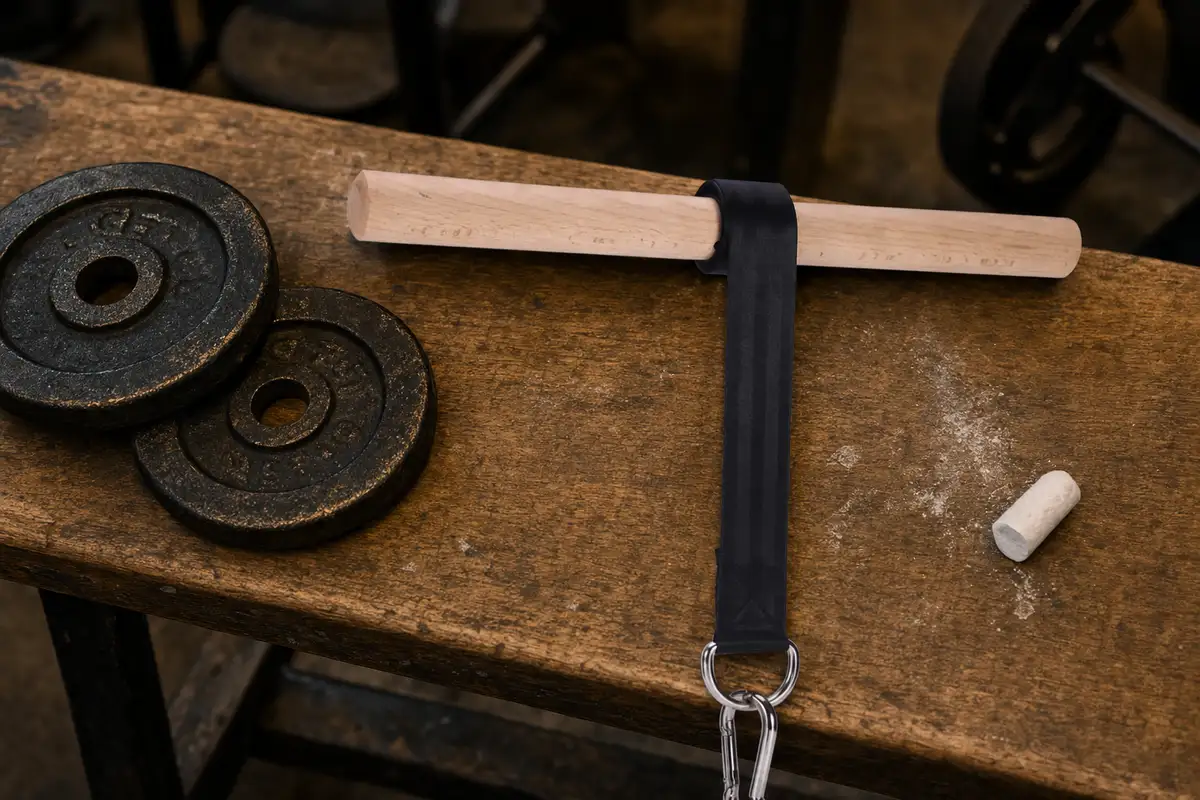
This is the most common either-or question in forearm training, and the honest answer has more nuance than a store that sells one of the two tools would usually admit. We sell the roller. Here is the comparison we would want to read anyway.
Two different movements wearing the same label
Both tools flex and extend the wrist against load, and the resemblance ends there. A wrist curl bar (or a regular barbell over a bench) moves through a short arc, heavy, for sets of 8 to 20 reps, with rest at the bottom of every rep. A roller never rests: the load hangs from a strap the entire set, your fingers re-grip every rotation, and one rep lasts as long as a whole set of curls.
| Wrist roller | Wrist curl bar | |
|---|---|---|
| Movement | Continuous winding, both directions | Short-arc curls, one direction per set |
| Muscles | Flexors, extensors and grip in one set | Flexors mostly, extensors only if reversed |
| Tension | Constant, no resting point | Peaks and rests every rep |
| Max load | Moderate, leverage multiplies it | Heavy, best for low-rep strength |
| Grip work | Built in, unavoidable | Minimal, bar sits passively |
| Setup | Freestanding, no bench needed | Bench or knees, plates required |
Where the roller is simply better
Grip endurance and extensor development. Curls let the bar sit in passive fingers; rolling forces an active re-grip every rotation, which is why a 60-second roll leaves your hands cooked in a way three sets of curls never will. And the top of the forearm, the extensor side that balances your wrist and fills out the arm when viewed from above, gets trained on every single unwind. Curl-only lifters usually have a visible gap there. The muscles-worked breakdown goes deeper.
Where the curl bar is better
Absolute flexor strength. If your goal is a bigger wrist curl number, sport-specific flexion power for arm wrestling, or you respond best to heavy 8-rep work, a loaded bar lets you go far heavier than any roller. Reverse curls with the same bar also hit the extensors respectably. The curl bar assumes you own plates and a bench, which most home lifters buying forearm tools already do.
Cost and the equipment you already own
Neither tool is expensive next to what it replaces. Our roller is $29.99, and any straight bar you own becomes a curl bar for free. At the premium end, IronMind's knurled steel roller lists at $109.95 on their store (ironmind-store.com, 2026), which says something about what committed grip athletes will pay for this movement. If you own plates, the honest budget answer is: buy the roller, use your existing bar for curls, and you have both systems for under $30 of new money, with a loading pin serving both.
Or run both, on a split that makes sense
They stack cleanly because they stress different qualities. Heavy curls early in the week build flexor strength; rolling later in the week builds endurance and extension balance. That structure also satisfies the 2+ muscle-strengthening days per week that the U.S. Physical Activity Guidelines (HHS, 2018) set as the baseline for adults. Our workout guide shows where the roller sessions slot in.
Verdict
Pick the roller if you want visible forearms, a grip that lasts and one tool that covers everything. Pick the curl bar if pure flexion strength is the goal and you already own the plates. Pick both if forearms have become a project instead of an afterthought. We are a wrist roller store, and even so: the curl bar is not the enemy, neglect is.
Whichever tool wins your vote, give the decision eight weeks before you re-litigate it. Forearm tissue adapts on tendon time, not on program-hopper time, and either tool trained twice a week for two months will settle the question with evidence your sleeves can see.